
A sudden, high-frequency whistle from your hearing aid can trigger immediate annoyance and disrupt communication if left uncorrected. Our clinical team will evaluate your hearing aid to discover whether loose fit, earwax buildup, gain levels, aged tubing, or hardware defects cause the noise. Discover the biological and mechanical drivers of feedback, along with safe home-troubleshooting steps that resolve minor complaints and indicate when clinical care is warranted.
The Mechanics Behind Hearing Aid Feedback
Squealing or whistling from an amplification device typically represents acoustic feedback. An external microphone picks up speech, internal processing components amplify the signal, and the receiver directs the acoustic output toward the eardrum. If amplified sound escapes the ear canal and reaches the microphone again, the device reamplifies it and creates a squeal or whistle.
Momentary whistling is normal during morning insertion or whenever a hand, headwear, telephone receiver, or physical embrace alters the acoustic pathway. Modern hearing aids have feedback-management systems, but they cannot prevent every short episode.
Whistling during ordinary use means too much sound may be leaking, blocked, or reentering the microphone. This physiological or technical defect should be clinically remediated instead of tolerating the squeal or keeping volume levels inappropriately reduced.
What Prompts Hearing Aids to Whistle?
Any factor that compromises the acoustic seal, obstructs sound emission, demands excessive gain, or damages internal components can cause feedback. Feedback issues often evolve slowly across extended use, even when your hearing aid performed flawlessly in the past.
Primary sources of device feedback include:
- A dome, earmold, or in-the-ear hearing aid that fails to seat entirely within the ear canal
- A physical earpiece that has deteriorated, shrunk, or no longer seals against the ear canal wall
- Excessive earwax occluding the canal pathway and reflecting sound backwards
- Debris obstruction across the wax filter, receiver port, acoustic vent, or sound tubing
- Volume or amplification set higher than the fitting can support
- Mechanical fatigue including ripped domes or aged acoustic tubing that has cracked and hardened
- Moisture accumulation or internal component failure compromising the receiver or microphone
- Progressive hearing loss changes demanding updated acoustic programming or different physical coupling
Mandibular action during normal eating, smiling, or conversation easily compromises an imperfect earpiece seal.
We can examine the ear and device when the trigger is unclear.
Is It Hearing Aid Feedback or Tinnitus?
True hearing aid feedback is an external acoustic signal emitted by your hardware. Feedback happens strictly while the hearing aid is energized, responding immediately when you change volume levels, adjust the earpiece, move reflective objects, or turn the unit off. Tinnitus is clinically defined as phantom sound perception in the central auditory system without an external source. The phantom sound can resemble whistling, continuous buzzing, rushing hissing, rhythmic clicks, or roaring inside the ears. Taking the hearing aid out of your ear will not eliminate tinnitus perception. Appropriate hearing aid amplification routinely reduces the perceived prominence of tinnitus for many individuals.
Step-by-Step Home Troubleshooting for Hearing Aid Feedback
Start by performing gentle external assessments that do not risk damaging internal components or probing your ear canal. Work exclusively with clean, moisture-free hands while resting your elbows over a padded surface to protect the instrument.
Implement the following corrective measures:
- Take out the hearing aid to confirm the color indicator matches the designated ear (red for right, blue for left).
- Inspect the sound bore, dome tip, receiver spout, and acoustic tubing for obstructive wax, splits, or loose connections.
- Remove superficial debris using only the authorized cleaning tools and maintenance protocols designed for your hearing aid.
- Install a new wax guard or fresh ear dome only if you are familiar with the correct mechanical technique.
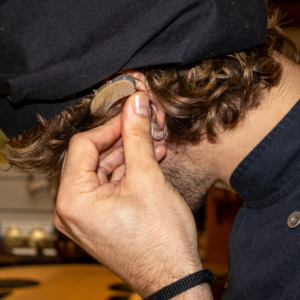
- Reinsert the earpiece fully into the canal, ensuring that the receiver wire or slim tube rests flush against the side of your head.
- Return the volume to its recommended setting.
- Clear away scarves, wide-brimmed hats, thick hair strands, and mobile phones from the external microphone ports.
- Restart the hearing aid system and verify that your disposable battery is fresh or your rechargeable battery shows full power.
Never expose your hearing aids to tap water, chemical cleansers, safety pins, or metallic implements unless explicitly cleared by the manufacturer.
Determining Whether Your Hearing Aid Is Defective or Misaligned
Squealing that ceases once you reseat the mold, replace a wax guard, lower the gain, or clear a phone away indicates user-level issues. Feedback emitted by an active hearing aid while resting in your open hand is normal because there is no sealed acoustic barrier. A physical device defect is suspected if the whistle continues unabated despite perfect positioning, clean wax filters, standard volume, and a snug seal. Other clear signs of damage include distorted speech processing, fluctuating volume, weak sound intensity, frozen controls, spontaneous shutdowns, dock charging errors, or physical cracks. Damaged tubing, receivers, microphones, or internal parts require professional service.
Compare the problematic instrument with your contralateral device to identify visual differences, but refrain from placing the wrong device in the opposite ear. We utilize clinical test boxes and diagnostic equipment to verify whether ultrasonic cleaning, parameter adjustment, fresh components, or factory servicing is necessary.
Indicators That Your Hearing Aids Need Physical Adjustment
A correctly fitted device should stay firmly anchored without generating continuous pressure, friction, or pain. An inadequate canal seal permits amplified audio to leak out, most noticeably during conversational speech, eating, or normal jaw motion.
Documented indicators of physical fit problems include:
- Frequent acoustic feedback flaring up during ordinary sedentary use
- An earmold or dome tip that constantly backs out of the canal aperture
- A thin wire or sound tube that bows out awkwardly instead of tracing the natural ear contour
- An instrument that moves out of position during basic smiling, chewing, or conversing
- Cutaneous soreness, focal redness, frictional rubbing, or painful canal pressure points
- An unrelenting, unnatural sense of aural fullness or occlusion that fails to subside
- Sound output that stabilizes or changes volume only when you press the mold further inside
The structural shape of the ear canal changes naturally with age and weight shifts, while domes, tubing, and custom molds degrade. An adjustment may involve a different dome size, receiver length, new tubing, a remade earmold, or revised programming.
Schedule a Clinical Hearing Aid Check
Frequent feedback squealing does not necessarily mean you must invest in brand-new hearing aids. Schedule an evaluation with our audiology team for a thorough assessment of your canal health, hearing thresholds, physical device fit, and real-ear output performance. Our specialists can identify whether you require professional cerumen removal, revised software programming, new acoustic tubing or domes, a remade custom mold, or manufacturer repairs.
Get in touch with our team today to request a professional hearing aid check.